Video Content
Written Content
NAVEE is already a household name in the micro-mobility sector that has cemented themselves as a top-tier electric scooter brand in Europe, rapidly expanding across the United States. However, their recent "No Limit" launch proves the company is no longer content with just dominating the pavement. Instead, NAVEE is aiming for total multi-terrain supremacy, expanding its innovative horizons to conquer the land, the sea, and the air.
In a massive pivot from standard micro-mobility towards AI-integrated robotics, aviation, and human augmentation, NAVEE executives recently revealed a groundbreaking, tech-heavy lineup. Here is a deep dive into the hardware they are bringing to the market, along with an analytical look at how these ambitious projects might actually fare in the real world.
Conquering the Water: The Wavefly 5X
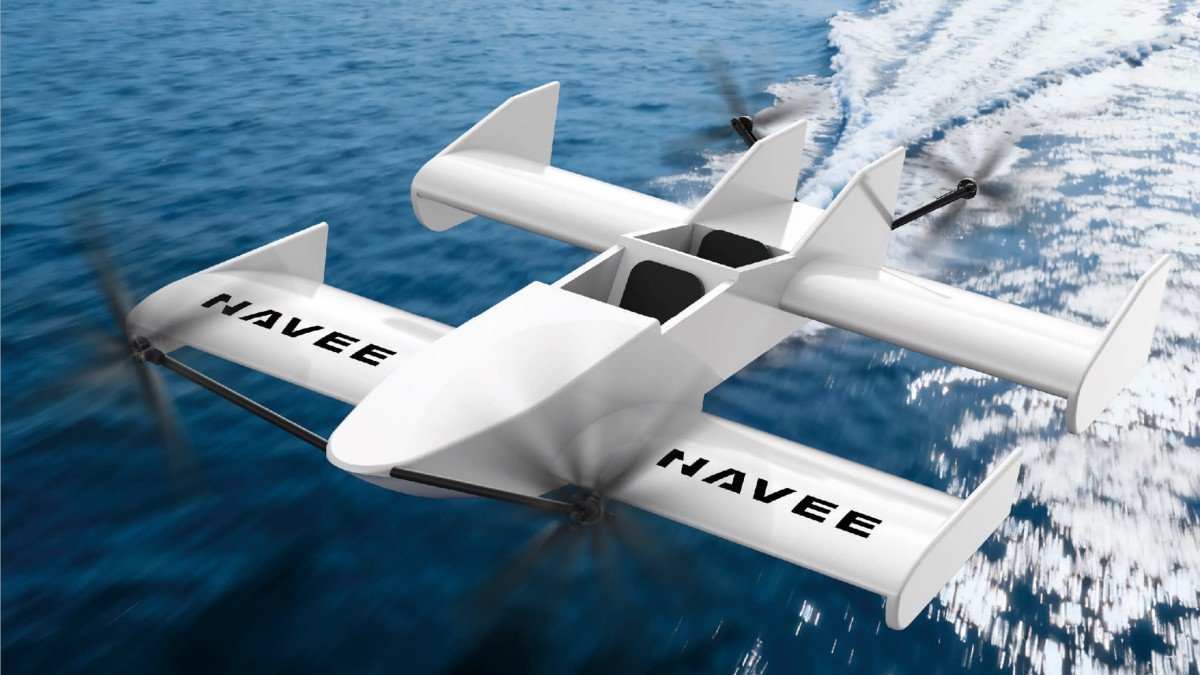
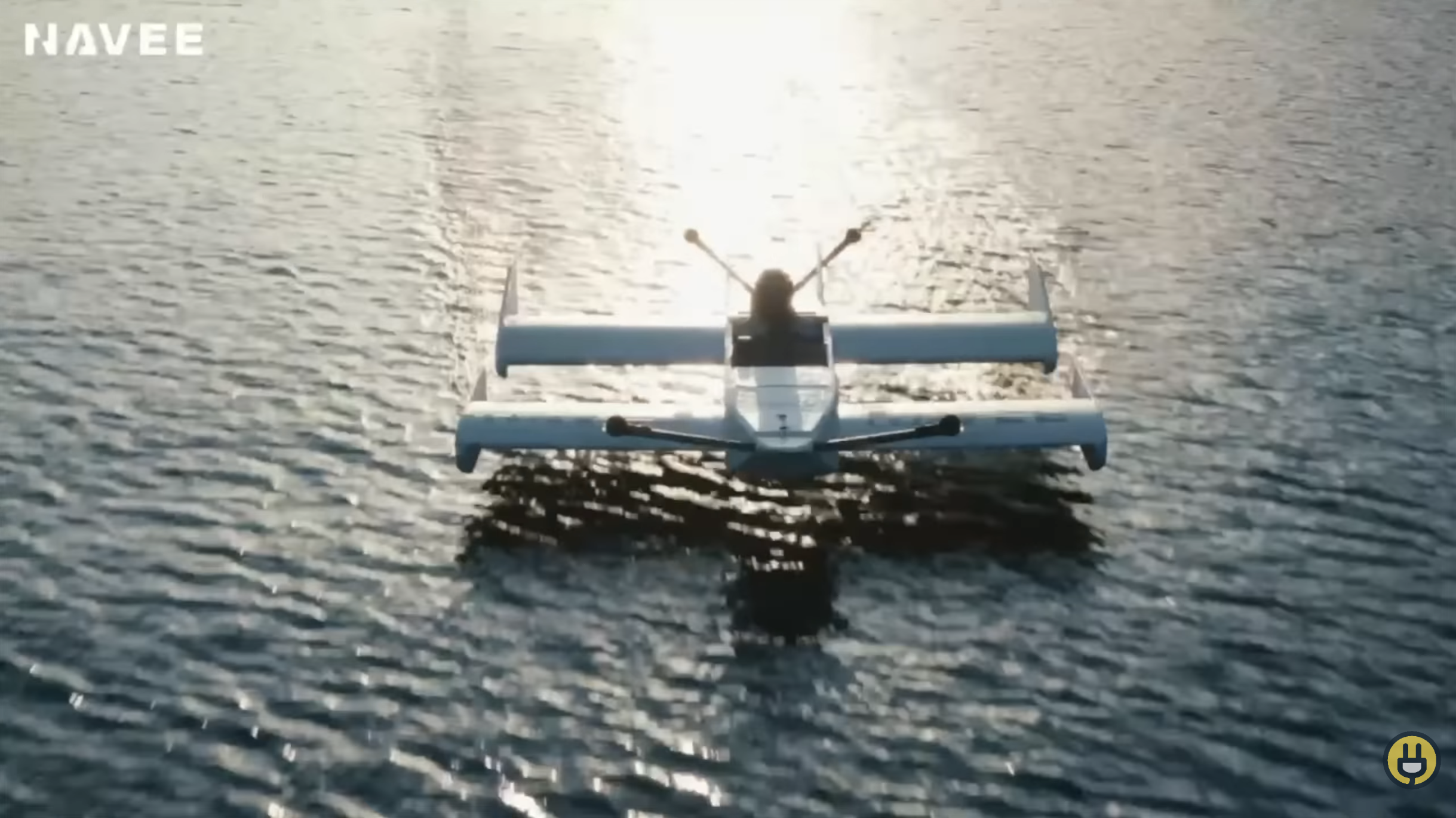
Perhaps the most surprising and immediate release from NAVEE is the Wavefly 5X, an aquatic mobility vehicle that blurs the line between a traditional boat and a low-altitude aircraft. Rather than using traditional aquatic propulsion or underwater hydrofoils, the Wavefly 5X features a boat-like hull combined with aerodynamic wings and rear-mounted propellers. It utilizes heavy wind thrust generated from the rear to physically lift the craft out of the water, allowing it to glide seamlessly at hover heights of a foot—and reportedly much higher—above the water's surface.
From a tech reviewer's perspective, the most shocking aspect of the Wavefly 5X is that it isn’t vaporware. The personal watercraft market is littered with wild CGI renders of hoverboards and flying jet skis that never see production. NAVEE, however, already has working prototypes in their factories and has officially opened the Wavefly 5X for pre-orders. By relying on wind thrust and a ground-effect style hover rather than complex submerged foils, NAVEE might have bypassed the fragility that usually plagues high-tech watercraft.
The Market Play: If the retail version holds up to the prototype's promises, the Wavefly 5X is poised to carve out an entirely new "halo" tier in aquatic recreation. While it likely won't immediately cannibalize the standard jet ski market due to what we can assume will be a premium price tag, it is going to be the ultimate status symbol for yacht owners and high-end watersports enthusiasts. If the battery density allows for decent runtimes, this could even introduce a new niche of ultra-smooth coastal commuting.
The Next Decade of Flight: NAVEE’s eVTOL
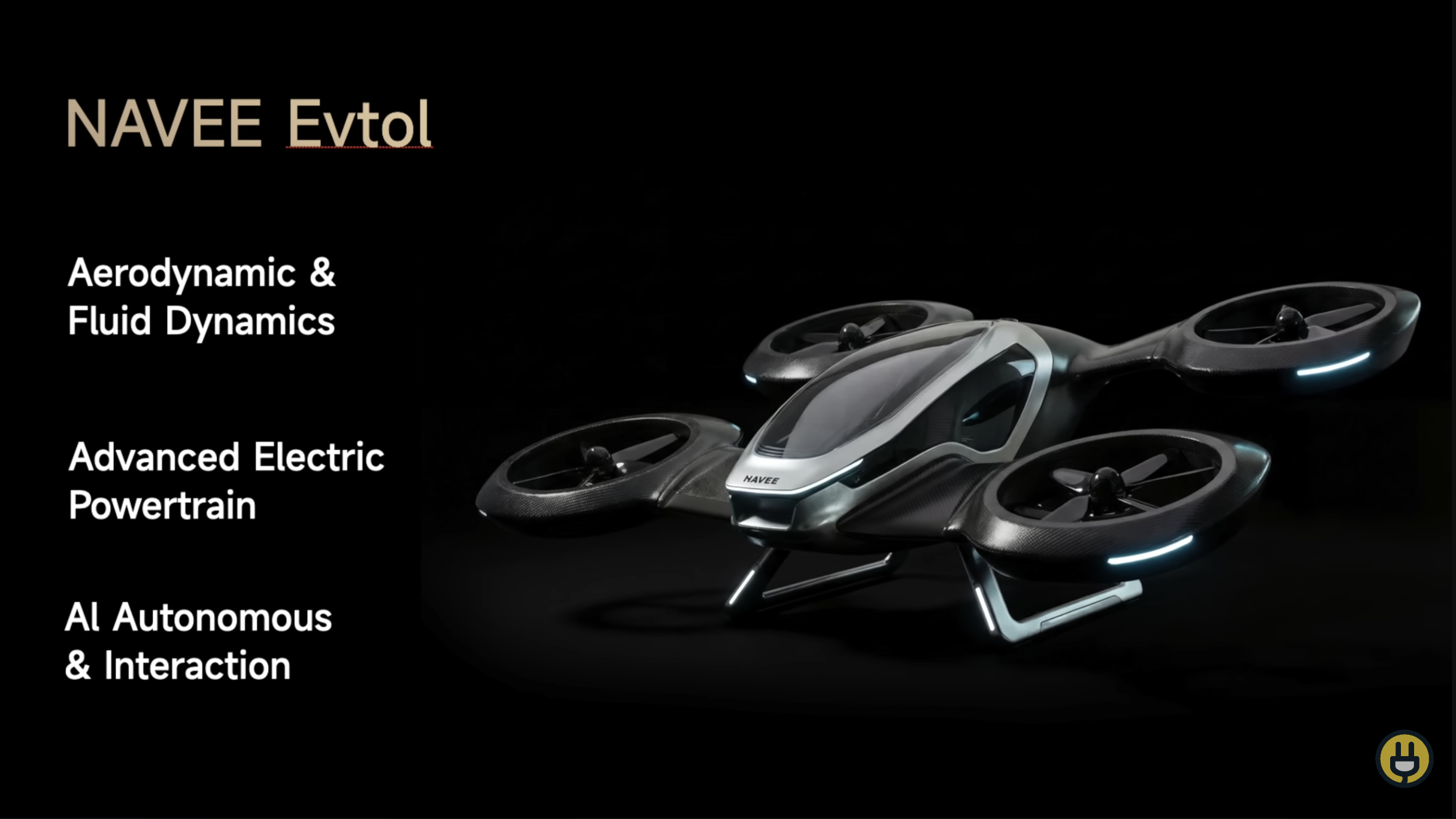
Looking ahead to the next 10 to 20 years, NAVEE is aggressively developing its own Electric Vertical Takeoff and Landing (eVTOL) vehicle. Described as a manned "quadrocopter," NAVEE is leveraging highly mature drone technology to build a personal, private flying aircraft. Rather than requiring a complex aviation background, NAVEE aims to make piloting as intuitive as flying a DJI consumer drone. The fly-by-wire controls will be vastly simplified—relying on software to handle pitch, yaw, and stabilization, while the user simply inputs basic commands like "lift up, push forward, and back."
As analysts in the tech space know, the eVTOL sector is currently dominated by commercial air-taxi startups like Joby and Archer. NAVEE’s pivot toward personal ownership is a massive, ambitious swing. The hardware isn't actually the biggest hurdle here; battery energy density and multi-rotor stabilization are already well understood. The true bottleneck will be the FAA and global equivalent regulatory bodies. NAVEE is intentionally taking a methodical development process to ensure legal compliance, and their 10-to-20-year timeline is refreshingly honest for a tech industry that usually over-promises on autonomous flight.
The Market Play: Initially, this will strictly be a billionaire's plaything, entirely dependent on how airspace regulations adapt to personal aircraft. However, by designing the interface around intuitive drone controls rather than traditional helicopter yokes and pedals, NAVEE is future-proofing their user base. They recognize that for personal eVTOLs to succeed, the barrier to entry for piloting must be practically zero.
Autonomous AI Energy: The MOI Power Station
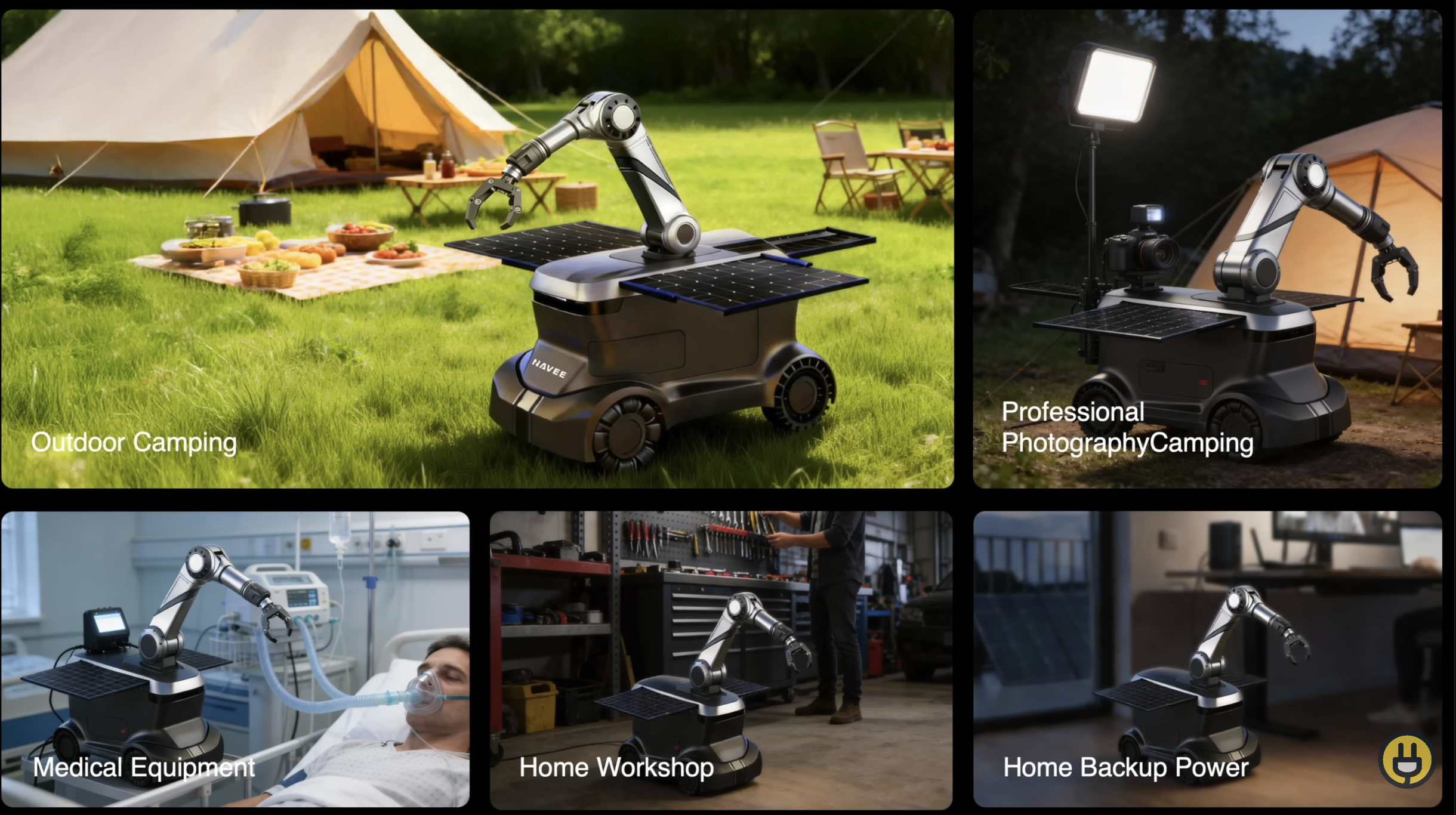
Moving away from passenger vehicles, NAVEE is redefining portable power with the MOI Power Station. This is far more than a standard camping generator; it is an autonomous robotic companion. Utilizing built-in AI technology, the MOI Power is entirely self-propelled and will physically follow you around—whether you are hiking to a remote campsite, walking a job site, or dragging gear to a ski lift. It also captures solar power to sustain its battery life and features a built-in "utility arm" to carry extra heavy equipment, eliminating the need to manually lug a heavy generator on wheels.
The portable power station market has exploded in recent years, but companies have hit a physical wall: massive battery capacity equals massive weight. NAVEE’s solution to add autonomous mobility is brilliant. Instead of trying to make a lighter battery—which sacrifices capacity—they turned the battery into a robotic pack mule. The success of this unit will hinge entirely on the robustness of its AI tracking and the torque of its motors. If it struggles to navigate over roots, rocks, or snow, the illusion breaks.
The Market Play: This has massive crossover appeal. Beyond the obvious camping and off-grid applications, the MOI Power Station could be a game-changer for professional film crews, outdoor event organizers, and construction workers. If the utility arm is modular and the AI tracking is as seamless as advertised, the MOI could dominate the premium tier of the portable power market, making standard wheeled generators look archaic.
Redefining the Greens: The F1X Smart Caddy
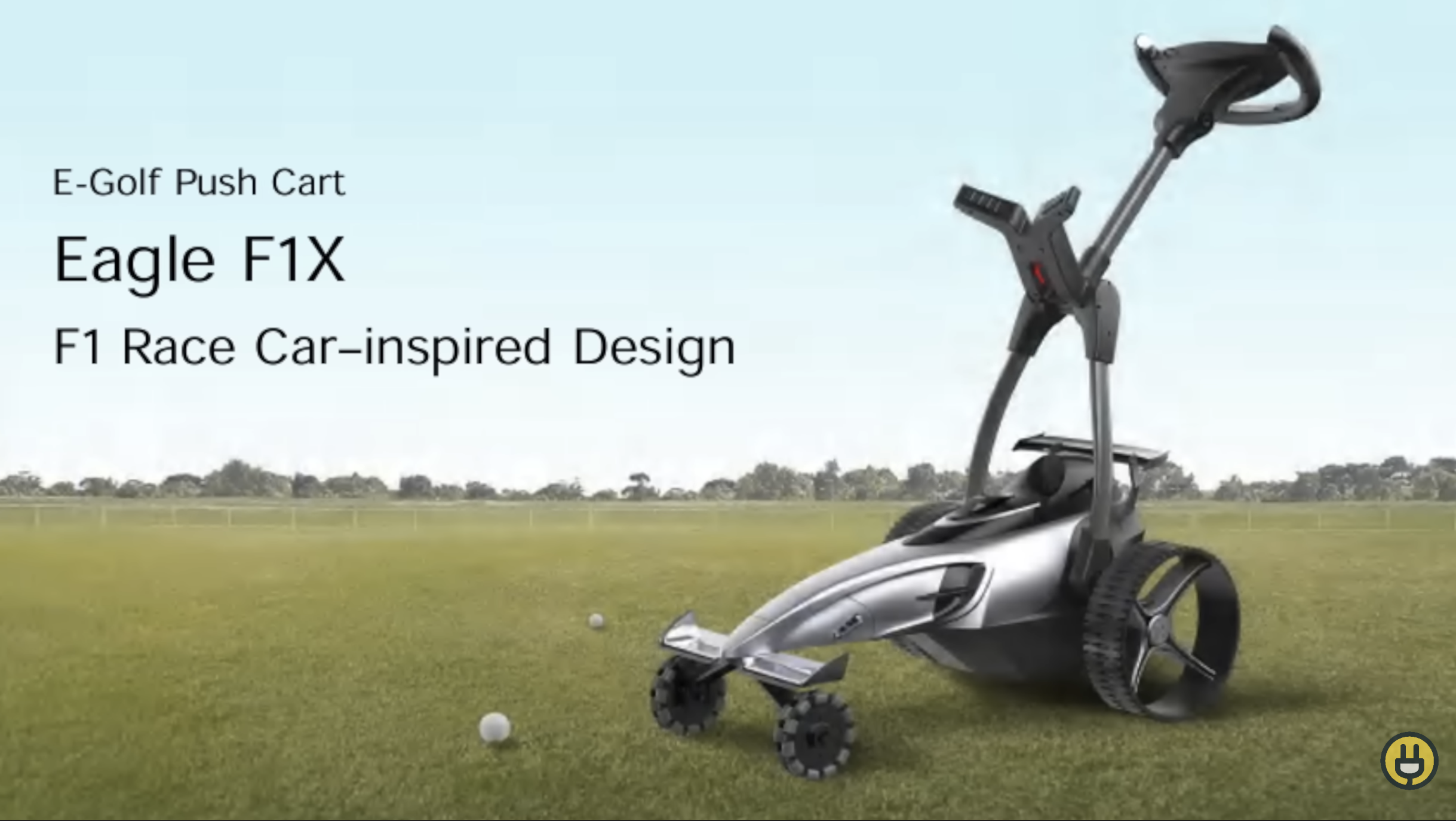
Golfers are getting a highly sophisticated AI companion with the introduction of the F1X Smart Caddy. Engineered to be completely independent of smartphone tracking or companion apps, the F1X uses an embedded camera to visually lock onto the user and follow them autonomously. It comes pre-loaded with over 40,000 embedded golf course maps, accessible via an interactive touchscreen. Thanks to internal GPS and smart environmental sensors, it features advanced obstacle avoidance. You can even tap a location on the map, and the caddy will independently drive to that exact spot.
From a hardware perspective, implementing pure vision-based tracking rather than relying on an ultra-wideband (UWB) remote fob is a massive leap forward for consumer golf tech. It allows for natural interactions: the caddy responds dynamically to hand gestures (like waving to initiate a follow or gesturing to stop) and voice commands. The feature that allows you to send the caddy to a friend on a completely different hole proves that this isn't just a follow-bot; it is a fully mapped, self-driving autonomous vehicle scaled down for the fairway.
The Market Play: The golf demographic is famously willing to spend heavily on premium gear to improve their experience. Existing remote-control caddies are popular but clunky. The F1X is the ultimate flex for the individual buyer. Furthermore, high-end country clubs could easily purchase fleets of these to lease to members, offering a caddy experience without the need for human staffing.
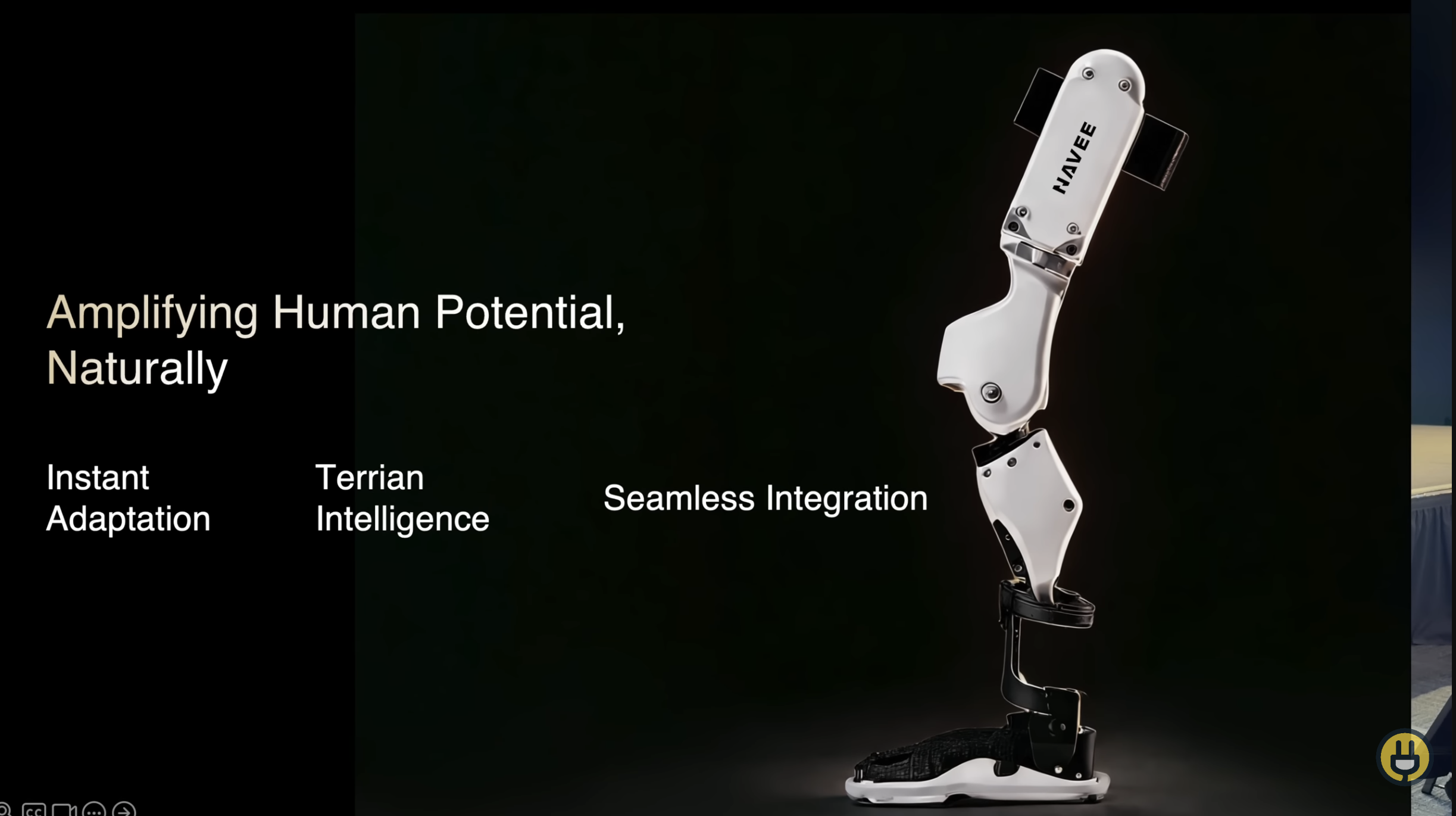
Human Augmentation: The Exopit Exoskeleton
While exosuits are heavily utilized in industrial, military, and medical sectors, NAVEE is consumerizing human augmentation with the Exopit. Built for the everyday person, the Exopit is designed to provide extra physical leverage for household chores, carrying heavy equipment, or mitigating physical fatigue. Unlike minimalist, belt-style back braces, the Exopit provides a massive range of body coverage. It actively manages weight distribution across the hips and extends all the way down to the shins to completely protect the knees and lower body joints.
Reviewing consumer exoskeletons is tricky because the line between "helpful tool" and "cumbersome gadget" is incredibly thin. NAVEE is attempting to bring robotics directly into the home garage. The fact that they included full leg support down to the shins shows they are serious about load mitigation, not just posture correction. The challenge here will be battery life, actuator noise, and above all, comfort. If it takes 20 minutes to strap into the Exopit, the average consumer will just opt to carry their heavy boxes the old-fashioned way.
The Market Play: This is an uncharted, high-risk, high-reward market. The potential demographics are vast: aging populations who want to maintain their independence in the garden, DIY enthusiasts tackling home renovations, and even warehouse workers purchasing their own gear. If NAVEE prices the Exopit like a high-end power tool rather than specialized medical equipment, they could be the first company to successfully normalize the everyday use of exoskeletons.
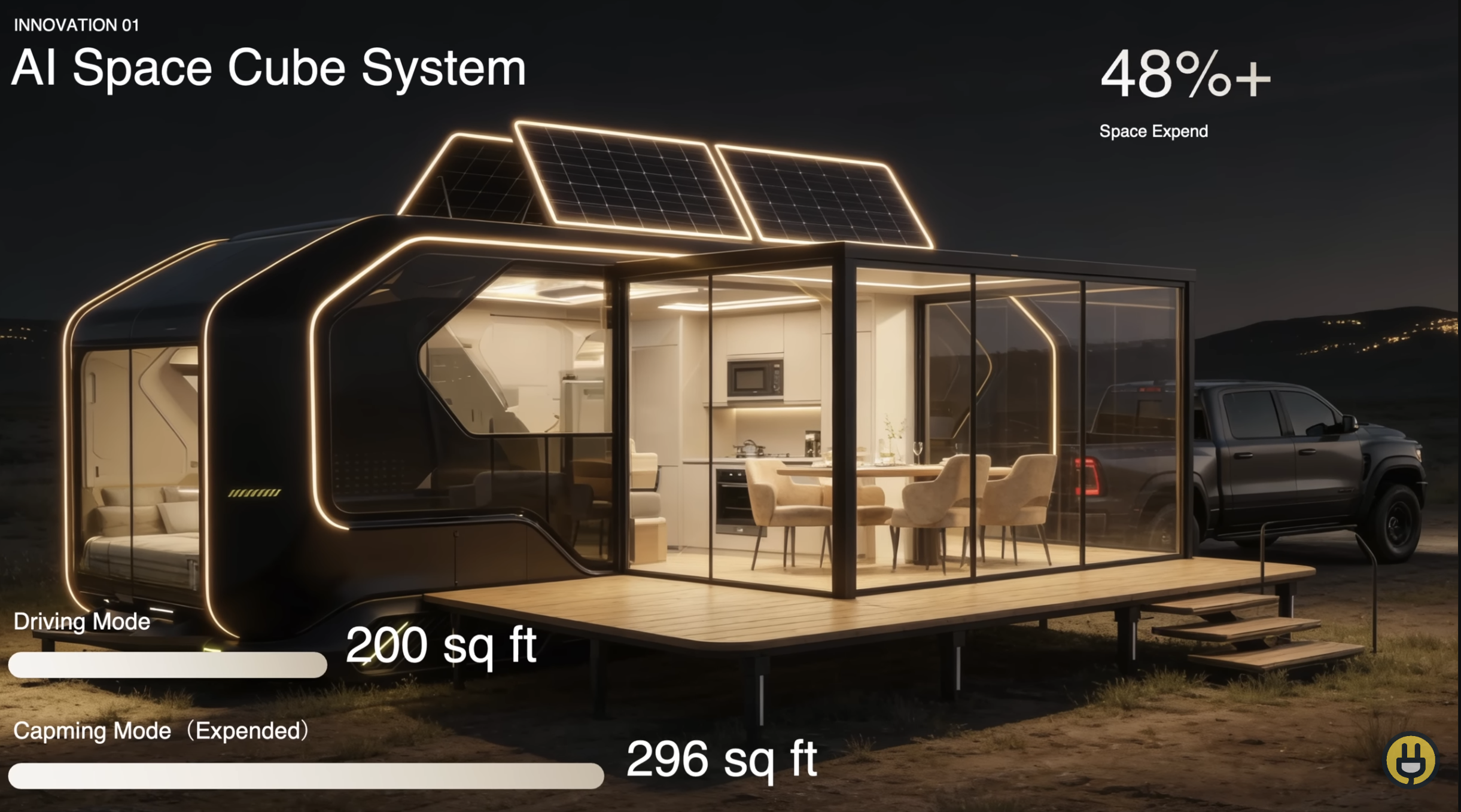
The Future of Glamping: The Space Cube
Finally, NAVEE introduced the Space Cube, a revolutionary expanding mobile habitat designed for luxury camping. Once parked, the Space Cube physically expands its footprint, growing from a standard 200 square feet up to a roomy 300 square feet. Because towing heavy trailers is notoriously difficult and intimidating for newcomers, NAVEE integrated an AI power-assist system that actively helps maneuver and turn the weight of the trailer while it is being towed. Internally, the AI controls all the devices within the living unit and makes automatic adjustments to adapt to different environmental terrains.
The RV and "glamping" space has seen a massive influx of tech recently, but NAVEE is tackling the two biggest friction points of trailer ownership: the terrifying driving experience and the cramped living quarters. The AI towing assist is the standout feature here. By implementing what sounds like active sway control and motorized torque vectoring on the trailer's own wheels, the Space Cube effectively lightens the load for the tow vehicle. Combined with the mechanized expansion to 300 square feet, it acts as a literal smart-home on wheels.
The Market Play: The Space Cube is going toe-to-toe with luxury EV smart-trailers from startups like Pebble and Lightship. The target audience isn't the rugged survivalist; it’s the affluent family that wants the comforts of a high-end hotel room dropped into the middle of a national park. If the AI towing assist works seamlessly with standard consumer trucks and SUVs, it drastically lowers the barrier to entry for folks who have the budget for an RV but lack the confidence to haul a massive box down the highway.
The Freshly Charged Verdict:
NAVEE’s presentation aggressively signals that the brand is outgrowing its roots. By intertwining mature EV battery tech, advanced AI tracking, spatial mapping, and drone aerodynamics, NAVEE is actively laying the groundwork for how we will camp, golf, lift, sail, and fly over the next twenty years. The transition from concept to consumer product is always fraught with delays and compromises, but if NAVEE can deliver even half of the specs promised, they are about to become a dominant force in autonomous lifestyle technology.
No comments yet…