RTK stands for Real-Time Kinematic, and it's the technology behind the biggest leap wire-free mowers have made past basic GPS. Standard GPS can put a mower's position within a few meters, fine for general location, useless for a precise mowing boundary. RTK corrects that down to centimeter-level accuracy by comparing the mower's satellite signal against a fixed reference point, which is what makes it possible to set a virtual lawn boundary with a phone app instead of burying a wire around the whole yard.
The technology has moved fast in the past couple of years. Early RTK systems needed a physical base station antenna installed somewhere on the property, tied to that one mower by radio signal. Network RTK, often shown as NRTK, pulls the same correction data over a cellular or WiFi connection instead, skipping the antenna setup entirely and making installation close to plug-and-play.
Some weak points exist. RTK depends on a reasonably clear view of the sky, so dense tree cover or a home close to tall buildings can degrade the signal, which is why a lot of RTK-based mowers pair it with a secondary system, cameras or LiDAR, to keep navigating through the dead zones until the signal clears. It also tends to sit at a higher price point than basic boundary-wire or vision-only models, a fair tradeoff for most buyers given what it replaces: no trenching, no wire, and boundaries you can redraw from your phone in minutes.
-medium.jpg)
The Lymow One is a tank tread robot mower with an aluminum alloy frame, dual rotary mulching blades spinning at 6,000 RPM, and a navigation stack combining RTK GPS and VSLAM, which is a fundamentally different machine from the plastic, razor-blade robots that dominate the category. In a week of real backyard testing it never got stuck, handled 45 degree slopes and 2 inch obstacles without issue, and cut clean stripes even on longer grass. The main criticisms are real: it is loud, heavy at 77.6 lbs, the proprietary blades require purchasing direct from Lymow, the physical display is nearly useless, and the easily accessible battery is a theft risk. For complex or demanding yards it is the most capable robot mower the team has tested; for flat, well-kept suburban lawns the trade-offs may outweigh the gains.
-medium.jpg)
The Sunseeker X7 is a wire-free robotic lawnmower aimed at homeowners with large, complex yards of up to 0.75 acres, including properties with slopes, uneven terrain, and multi-zone layouts. It sits at the top of Sunseeker's residential lineup and is distinguished by its all-wheel drive system, RTK and Vision AI navigation (branded AONavi™), and a dual-disc cutting setup with a 14-inch cutting width. The X7 is positioned to compete with other AWD robotic mowers in the large-yard segment and has received the Red Dot Award and Plus X Award.
-medium.jpg)
The MOVA LiDAX Ultra 2000 is a wire-free robotic lawnmower from MOVA, a brand that also produces robot vacuums and pool cleaners. It sits in the middle of MOVA's LiDAX robotic mower lineup, positioned above the LiDAX Ultra 1000 and below the AWD and 3000 AWD models, and is aimed at homeowners seeking autonomous lawn care without the need for boundary wires or RTK setup. Key differentiators include the UltraView 2.0 system, which combines 360° 3D LiDAR with AI vision for mapping and navigation, along with AI-based obstacle avoidance, edge-cutting capability, and support for slopes up to 45%.
-medium.jpg)
The Mammotion Luba 3 AWD is a wire-free robotic lawnmower positioned at the higher end of the consumer market, designed for homeowners seeking autonomous lawn care without perimeter wire or RTK base station installation. It is built around what Mammotion describes as a Tri-Fusion Positioning system combining 360° LiDAR, NetRTK, and dual-camera AI vision, and features all-wheel drive intended to handle steep slopes. The Luba 3 AWD is available in multiple configurations covering lawns up to 1.25 acres, with varying battery capacities and cutting height ranges to suit different yard types and grass conditions.
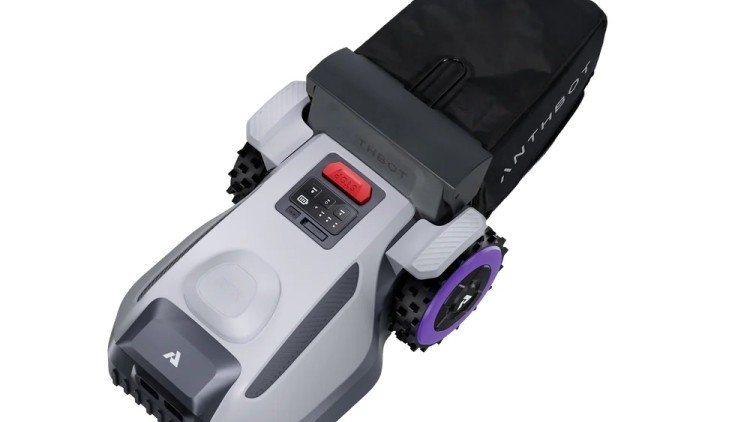
The Anthbot N8 is a multifunctional robotic lawn mower designed for residential yards up to 1,500m² (3/8 acres) that integrates mowing, mulching, collecting, and sweeping capabilities into a single unit. It utilizes a wire-free navigation system combining full-band RTK—which tracks signals from up to 155 satellites—and dual 150° HDR AI cameras to maintain positioning even in areas where satellite signals may be obstructed. The mower features a six-blade cutting disc operating at 4,000 RPM, an app-adjustable cutting height of 1.2 to 2.8 inches, and a 20cm cutting width. A central 23L collection bag manages clippings and debris, utilizing onboard sensors to detect fullness and navigate to user-defined dumping sites for autonomous disposal. Operational power is provided by a 9.2Ah battery, offering approximately 90 minutes of work per 80-minute charge, with a slope capacity of up to 45%. Safety and security features include AI-driven recognition of over 1,000 obstacle types, an IPX6 waterproof rating, GPS theft tracking, and an integrated rain sensor.
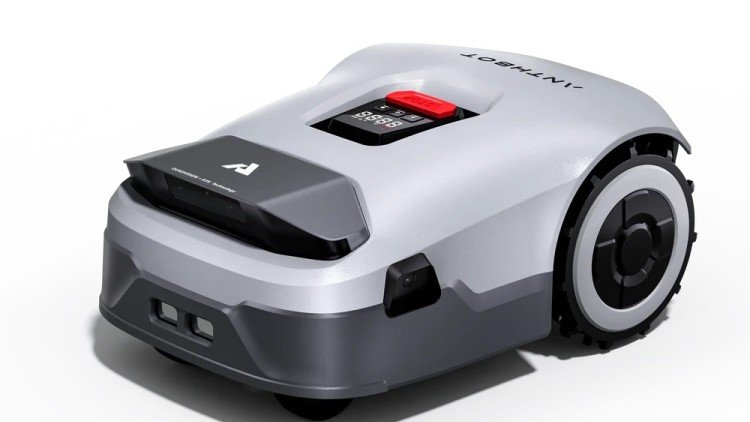
The Anthbot Genie is a series of autonomous, wire-free robotic lawn mowers available in the 600, 1000, and 3000 configurations, designed for residential properties up to 0.89 acres (3,600 $m^2$). The Genie 1000 is widely positioned as the series' best balance of features and value; consequently, the specifications detailed here primarily reflect that model, though performance metrics vary across the wider lineup. The system utilizes a navigation architecture that fuses Full-Band RTK satellite positioning with QuadVision technology—a four-camera AI vision system—to establish virtual boundaries without physical perimeter wires, supported by an 8-core CPU for 300° real-time avoidance of over 1,000 obstacle types. Rated for 0.49 acres, the Genie 1000 includes a 5Ah battery and integrated 4G connectivity, distinguishing it from the entry-level 600. Standard hardware across the range includes a 200 mm (7.9 in) five-blade disc with an electronically adjustable cutting height and a maximum climbing ability of 24°. While the entire series is IPX6 waterproof, the 1000 and 3000 models feature an enhanced security suite including GPS tracking, a digital fence alarm, and a PIN code lockout.
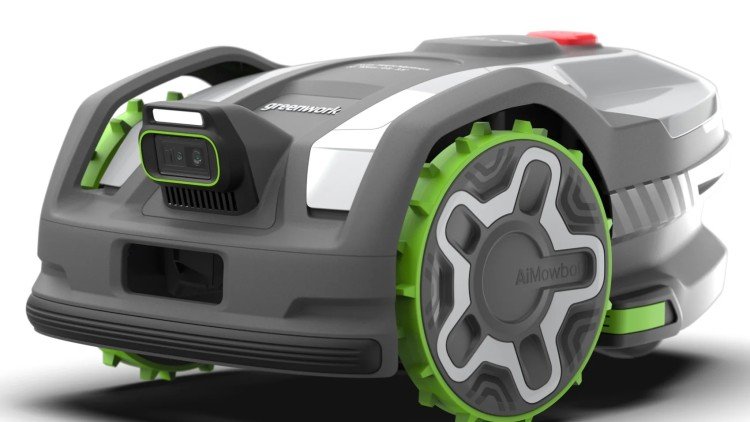
The Greenworks aiMowbot™ C20 is an autonomous robotic mower designed for residential properties up to 0.5 acres. It utilizes a wire-free navigation system that integrates RTK (Real-Time Kinematic) satellite positioning with AI-driven vision technology, allowing the unit to establish virtual boundaries and identify obstacles without the use of physical perimeter wires. This model features an all-wheel-drive (AWD) configuration, enabling it to operate on slopes with gradients up to 31° (60%). The cutting assembly consists of a three-blade mulching system with an electronically adjustable height ranging from 0.8 to 4.0 inches. Technical specifications include an IPX5 waterproof rating, integrated rain sensors, and connectivity via 4G LTE, Wi-Fi, and Bluetooth for app-based management. For security and maintenance, the system includes GPS-based anti-theft tracking and an auto-recharge and resume function.
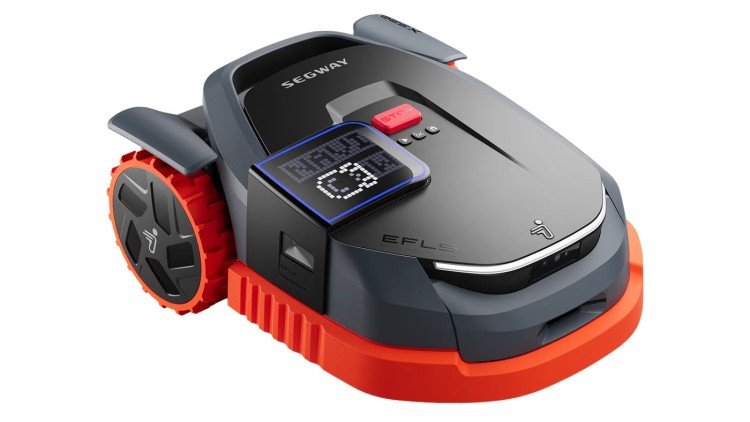
The Segway Navimow X390 is an autonomous robotic lawn mower designed for large-scale properties up to 2.5 acres (approx. 10,000 m²). It utilizes the EFLS 3.0 Exact Fusion Locating System, which combines RTK (Real-Time Kinematic) positioning with a 300° wide-angle VisionFence system to navigate without the need for physical boundary wires. This vision-integrated navigation allows the mower to maintain its orientation in areas with weak satellite signals and enables the detection and avoidance of over 200 types of objects, including pets and people, from up to three meters away. The X390 is equipped with a cutting system featuring a 9.3-inch cutting width and an electronically adjustable cutting height ranging from 2 to 4 inches. Technical performance specifications include a maximum slope capability of 50% (27°), a 240-minute mowing time per 100-minute charge cycle, and an IP66 waterproof rating for resistance against high-pressure washing. Additionally, the unit features an Expansion Bay for optional modular accessories, such as a semi-automatic edge trimmer, and supports multi-zone management via the Navimow app.
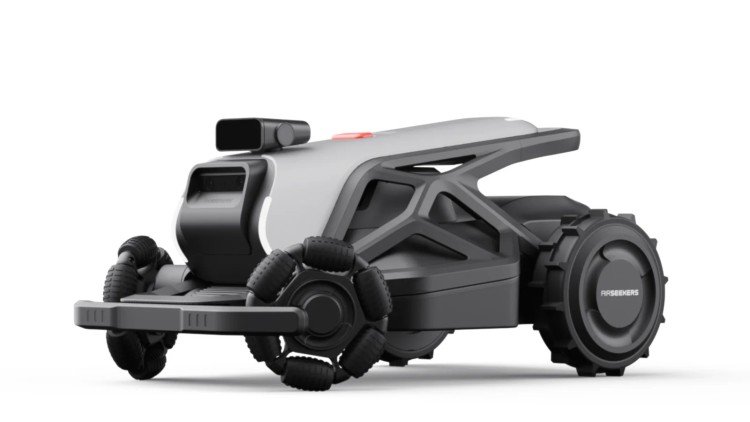
The Airseekers Tron is an autonomous robotic mower designed for residential and professional turf maintenance, specifically engineered to handle complex terrain and provide mulching capabilities. It utilizes the Omni-Navi system, which integrates a 300° AirVision 5-camera array with NetRTK (Network Real-Time Kinematic) positioning to navigate without physical boundary wires, even in environments with unstable satellite signals. The unit features a rear-wheel dual hub motor drive that enables it to climb slopes up to 65% (33°) and a 30° tilted front-wheel design intended for maneuverability on uneven ground. For cutting, the Tron employs a 400W motor powering a dual-layer disk with six pivoting razor blades, offering an adjustable cutting height of 30–90 mm and a cutting width of 220 mm. Technical specifications include an IPX6 waterproof rating, a swappable 15Ah battery providing approximately 180 minutes of runtime per charge, and AI-based obstacle detection for identifying pets and small objects. The model referenced here is the standard Tron, which is rated for a 24-hour mowing area of 0.6 acres (approx. 2400 m²) and a maximum capacity of 1.2 acres.