RTK stands for Real-Time Kinematic, and it's the technology behind the biggest leap wire-free mowers have made past basic GPS. Standard GPS can put a mower's position within a few meters, fine for general location, useless for a precise mowing boundary. RTK corrects that down to centimeter-level accuracy by comparing the mower's satellite signal against a fixed reference point, which is what makes it possible to set a virtual lawn boundary with a phone app instead of burying a wire around the whole yard.
The technology has moved fast in the past couple of years. Early RTK systems needed a physical base station antenna installed somewhere on the property, tied to that one mower by radio signal. Network RTK, often shown as NRTK, pulls the same correction data over a cellular or WiFi connection instead, skipping the antenna setup entirely and making installation close to plug-and-play.
Some weak points exist. RTK depends on a reasonably clear view of the sky, so dense tree cover or a home close to tall buildings can degrade the signal, which is why a lot of RTK-based mowers pair it with a secondary system, cameras or LiDAR, to keep navigating through the dead zones until the signal clears. It also tends to sit at a higher price point than basic boundary-wire or vision-only models, a fair tradeoff for most buyers given what it replaces: no trenching, no wire, and boundaries you can redraw from your phone in minutes.
-medium.jpg)
The Lymow One is a tank tread robot mower with an aluminum alloy frame, dual rotary mulching blades spinning at 6,000 RPM, and a navigation stack combining RTK GPS and VSLAM, which is a fundamentally different machine from the plastic, razor-blade robots that dominate the category. In a week of real backyard testing it never got stuck, handled 45 degree slopes and 2 inch obstacles without issue, and cut clean stripes even on longer grass. The main criticisms are real: it is loud, heavy at 77.6 lbs, the proprietary blades require purchasing direct from Lymow, the physical display is nearly useless, and the easily accessible battery is a theft risk. For complex or demanding yards it is the most capable robot mower the team has tested; for flat, well-kept suburban lawns the trade-offs may outweigh the gains.
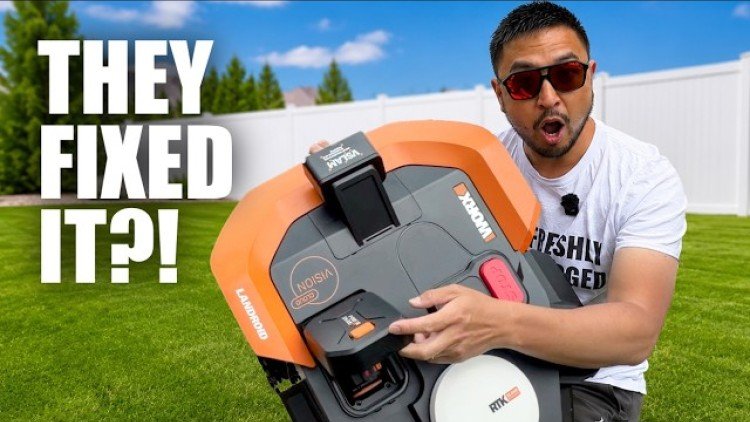
At $1,199, the WORX Landroid Vision Cloud two-wheel drive version makes a strong case for being the most capable budget robot mower the Freshly Charged team has tested. Andrew and Jimmy put it through two weeks of real-world use and came away impressed by two things that have historically let this category down at this price point: auto mapping that actually works and edge trimming that reliably cuts down the manual follow-up work. It is not perfect, but for a flat or moderately complex yard where all-wheel drive is not a requirement, the value for your money is hard to argue with.
-medium.jpg)
The Dreame A3 AWD Pro is a robot mower built for yards that present a real challenge, and after several weeks of testing across hills, exposed roots, and uneven terrain, Andrew found it handled the hard parts better than most. The EdgeMaster 2.0 edge trimming system is genuinely impressive when set up correctly, though the fixed 1.2 inch cutting height is a real limitation for anyone running their lawn taller. The overall ownership experience, from the toolless blade changes to the thoughtful security features, is what makes this one stand out.
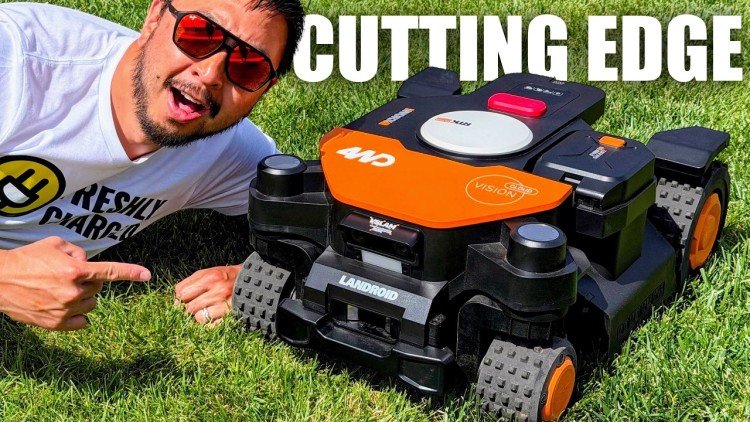
The WORX Landroid Vision Cloud 4WD is the first robot mower Andrew has tested that makes good on all three of its headline promises: no external RTK station, a base station that actually sits against your house, and edge trimming that actually reduces the need for a string trimmer. After a full week of real-world testing across a complex multi-zone yard, the results held up. If you have a demanding yard and a low tolerance for robot mower compromises, this new to the market product is worth a serious look.
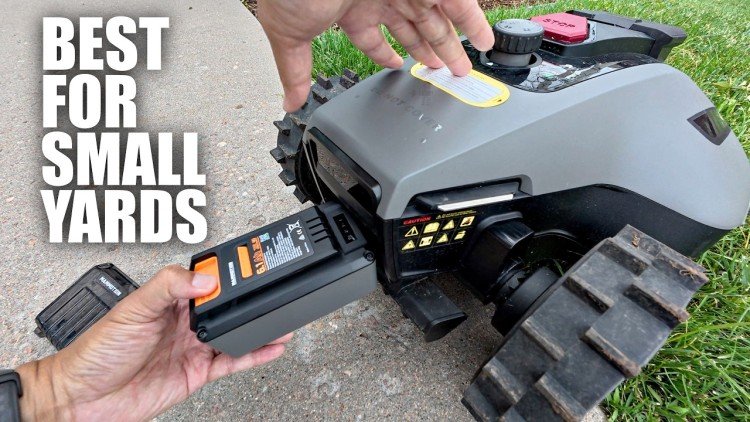
Mammotion's YUKA Mini is a wire-free robot mower built specifically for small urban and suburban yards, and it delivers a feature set that is a pleasant surprise at this price point. Jimmy put it through real-world testing including overgrown grass, surface roots, and an 18-degree hill climb, and the machine held up where it counts. It has limitations, as any robot mower does, but none that change the bottom line: if you have a small yard and you're done pushing a mower, this might be the one for you.
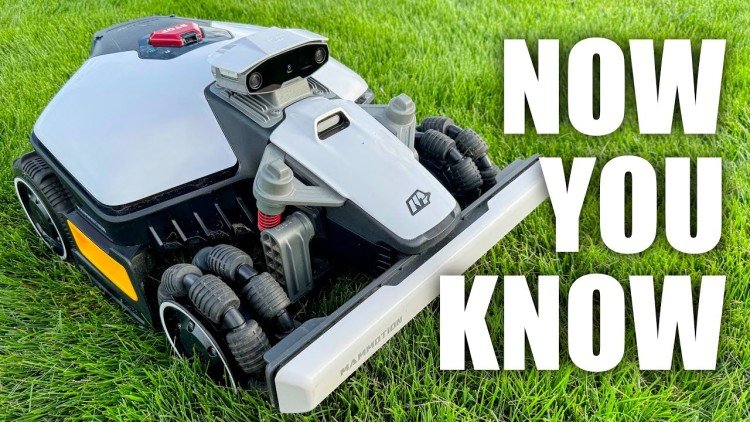
The Mammotion Luba Mini AWD is a compact robot mower built for smaller yards with real terrain challenges. A motor in every wheel, functional suspension, and an open cutting deck make it one of the more capable designs in the category. After six weeks of testing, the Freshly Charged team found it delivers on its core promise, but only for owners willing to put in the setup work. Auto-mapping needs improvement and the $29 dock cover should come in the box. For the right yard, it earns a recommendation from us.
-medium.jpg)
The Yarbo is a modular autonomous yard robot that swaps between mower, snowblower, trimmer, and leaf blower attachments on a single base unit. Build quality is premium, the app is solid, and the snowblower attachment is a standout. The mowing performs well on large open lawns but struggles with cut quality in tight, obstacle-heavy areas. The bigger issue is the early-adopter tax: setup is complex, connectivity drops happen, and troubleshooting typically means forums rather than fast support. For large-yard owners who value their time and are comfortable with capable-but-still-maturing technology, it delivers. Everyone else may want to consider other options or wait for the rough edges to smooth out.
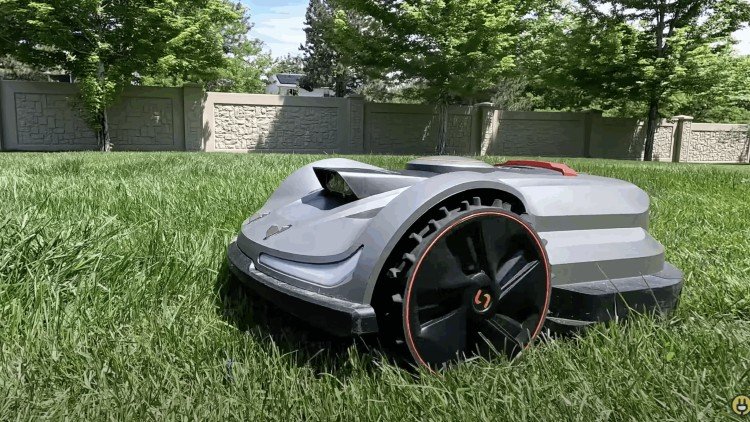
The Sunseeker Elite X7 Plus robotic mower combines advanced features like GPS-RTK mapping, AI obstacle avoidance, all-wheel drive, and ultra-quiet operation, making it a standout for hands-off lawn care. Designed for mid-to-large yards, it excels at handling hills and complex terrain with an intuitive app for setup and control—ideal for tech-savvy homeowners.
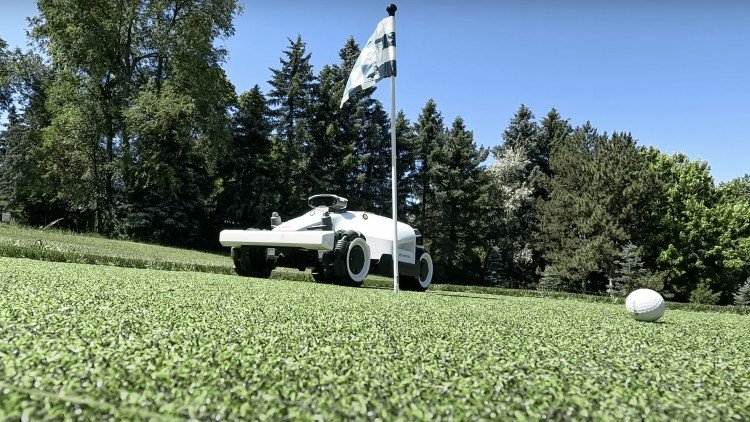
The Mammotion Luba 2 AWD robotic lawn mower impresses with its sleek design, powerful terrain handling, quiet operation, and smart autonomous features, making lawn care easy and efficient. While software updates and pricing could be improved, the Luba 2 shines for those with challenging yards, though flat-lawn owners might prefer alternatives like the Segway Navimow.
-medium.jpg)
The ANTHBOT M9 is a wire-free robotic lawnmower designed for urban and suburban lawns up to 1,000m², positioned as a compact, AI-driven option for homeowners seeking low-effort lawn maintenance. It uses a combination of RTK GPS, dual HDR cameras, and built-in 4G connectivity for navigation and remote control via a smartphone app, without requiring boundary wire installation. Its notably compact body is intended to handle narrow passages and tight corners that larger robotic mowers may struggle with. At the time of writing, the M9 is available for pre-order directly from ANTHBOT.
-medium.jpg)
The Segway Navimow X330 is a wire-free robotic lawnmower from Segway's Navimow X3 series, designed for lawns up to 1.0 acre. It positions itself in the higher end of the consumer robotic mower market, differentiating itself with EFLS 3.0 centimeter-level RTK positioning, AI-assisted mapping, and a vision-based obstacle avoidance system capable of detecting people, animals, and common yard objects. Setup requires no boundary wires and is designed to be completed without professional installation, while smart home integration via Alexa and Google Home adds scheduling convenience.
-medium.jpg)
The Segway Navimow i2 AWD is a wire-free robotic lawnmower from Segway's Navimow lineup, designed for small to mid-sized yards up to 0.25 acres. It is positioned as an entry-level AWD option in the i-series, targeting homeowners who want autonomous mowing without boundary wire installation. Key differentiators include all-wheel drive with an automotive-grade electronic speed controller for slope and terrain handling, a zero-turn third-wheel steering system, and tri-frequency Network RTK navigation fused with vision technology for centimeter-level positioning accuracy.