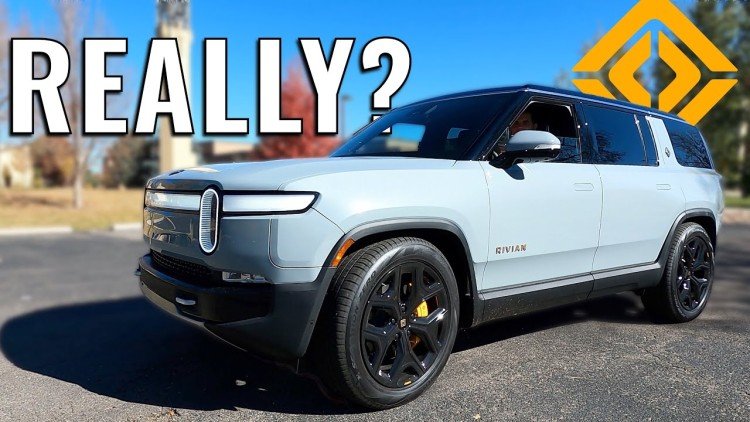
Jimmy teams up with Scott Lunt, aka Rivian Dad, for a full walkthrough and test drive of the Rivian R1S, the three row SUV sibling to the R1T truck he's been living with for a year. Beyond covering what's changed (ride height, cabin storage, third row seating) and what hasn't (the same wireless charging pad gripe, the same over engineered climate controls), the pair get behind the wheel to see if it lives up to the highest score Doug DeMuro has ever given a car. Both hosts come away convinced it does, calling it an entirely new class of vehicle that drives like a sports car and off roads like a truck.

Andrew visited BayFoils, a certified Fliteschool location on San Francisco Bay, to find out whether a $350 professional eFoil lesson is worth it before committing to a Fliteboard of your own — the short answer is yes. With wetsuits, helmets with two-way radios, and experienced instructors guiding you through every minute on the water, the Fliteschool experience is the fastest and most accessible way to find out if eFoiling is for you.

Our first monthly PEV roundup features the end of New Jersey's e-bike grace period, new federal tariffs on bike-industry supply chains being finalized, and the CPSC proposing what would be the first mandatory federal battery-safety standard. Add a public win against counterfeit safety certifications, Lime's Wall Street debut, a fresh CPSC stop-ride order, and a handful of new e-bike and scooter launches, and July turned out to be a packed month.

The e-bike "class system" most riders assume is settled federal law is actually just an industry model bill created over a decade ago. In 2026, it's fraying under the weight of faster, harder-to-classify devices and a wave of new state legislation. We break down why the framework never had the authority everyone assumed, why states are responding so differently, and what it means for riders of other PEVs who were never covered by it to begin with.

Jimmy has spent eight years watching public opinion shift on electric rideables, and this post zooms out to ask a bigger question: has this happened before? Tracing five decades of moral panic — from 1940s hot rods to skateboarding, BMX, and snowboarding — the argument is that America has a reliable habit of trying to ban the things kids love most, yet each anecdote eventually ends in structured acceptance. The one thing that makes today different is social media, but we can still look back in history to see what we should be asking instead of leaping to bans.

Amidst the rising popularity of electric vehicles, Jimmy explains why he sold his four year old Tesla Model 3 just months after buying a Rivian R1T; pointing to a used EV market where tight new car inventory and still high gas prices had pushed resale values higher than he expected to ever see again. With four vehicles in the driveway and the Rivian better suited to hauling the family's scooters and OneWheels, the Tesla became the easy one to let go.

Jimmy from the Freshly Charged team runs through ten products and hacks for Onewheel riders, starting at sixteen cents and topping out around $299, covering everything from a simple foot pad sensitivity fix to a full 360 camera setup. Whether you are new to the hobby or a seasoned rider, there is likely something on this list worth adding to your kit.

Jimmy and Andrew put Velotric's Thunder 1 and Thunder 1 ST through their paces, finding two nearly identical, eerily quiet Class 1 e-bikes that don't look or sound electric at all. The duo differ mainly in security tech (Velotric's own GPS tracking app on the Thunder 1 versus Apple Find My on the ST) plus a handful of components like handlebar shape, chainring size, and frame sizing. Component quality, especially the Tektro brakes and Shimano Altus derailleur, impressed the team, though both bikes ship without a quick release seatpost or front wheel. The verdict: the Thunder 1 suits riders who want longer range and true GPS tracking, while the lighter priced, smaller sized Thunder 1 ST is the better fit for iPhone owners on a budget.

Andrew traveled to Gdańsk, Poland to ride with Adam Malicki, one of the most respected EUC riders on YouTube, who shared his five biggest tips and five biggest mistakes for electric unicycle riders of all skill levels. The tips cover foundational habits like wheel calibration, pedal angle adjustment, and speed awareness, while the mistakes section addresses everything from helmet use and group ride overconfidence to tire pressure neglect and basic EUC maintenance. Adam also closes with two bonus tips — mesh intercom systems for group rides and a simple bicycle bell for urban and trail riding — that are easy to implement and practically useful.

While Jimmy still loves his Rivian R1T after one year and 15K miles, he's got real gripes: a proprietary infotainment system instead of CarPlay, a power tonneau cover he calls the "Achilles heel," inconsistent highway assist, and fast tire wear from all that instant torque. He also flags smaller annoyances like a wireless charging pad that doesn't work and a finicky Bluetooth lock. But between major OTA improvements, a maturing companion app, and genuine off road and utility chops, Jimmy's verdict hasn't budged, he still calls it his favorite vehicle, and his brother is buying an R1S on his recommendation.

After eight years of reviewing electric rideables, Jimmy has watched the debate around electric dirt bikes go from curiosity to a cultural flashpoint, and he thinks both sides are missing the bigger picture. The bikes themselves are not the problem, rather unsupervised access to 60 mph machines, a social media algorithm that rewards recklessness over responsibility, and a parenting gap are. This post breaks down why blanket bans punish the device instead of the behavior, what a real incident involving a 14-year-old rider illustrates about the stakes, and what parents and communities can actually do about it.

Even after reviewing over 100 electric scooters and hitting speeds up to 80 mph, Andrew's favorite in 2026 is still the 2025 Segway GT3 Pro. In this Segway-sponsored video — where Andrew is upfront about having full creative freedom — he breaks down exactly why: a feature stack that no other scooter at this price point comes close to matching, a reliability record across 10+ Segway machines that his high powered scooters simply cannot touch, and a ride quality that holds up at 50 mph in rain, on light trails, and apparently even in front of a Colorado state trooper. It's not perfect, but after everything he has ridden, this is the scooter Andrew keeps coming back to.